Classroom Procedures
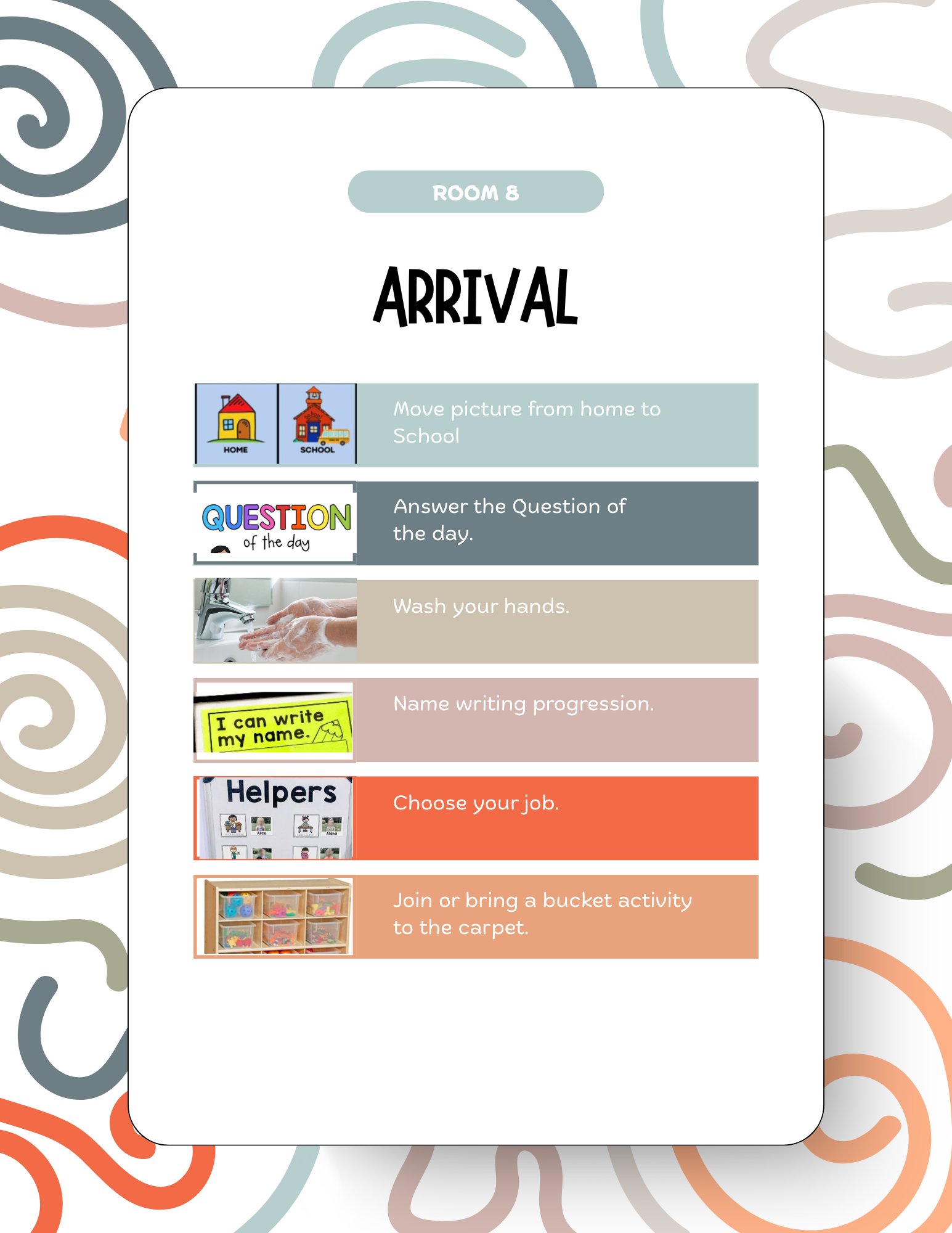
Routine Procedures
-
Enter the classroom with walking feet
Move picture from home to school
Answer the question of the day
Wash your hands
Go to your small group table and complete your name writing progression
Choose your job for the day
Join an activity or choose your own and bring to the large group carpet
-
Go to the sink
Dispense paper towels
Count “1-2-3-4, I don’t need anymore”
Turn on the water
Wet your hands in the water
Dispense soap into your hands
Scrub your hands together
“Fronts, Backs, and Inbetweens, That’s how I get my hands clean!”
Rinse your hands under the water
No more bubbles!
Rip off paper towels
Dry your hands
Use the used paper towels to turn the water off
Put used paper towels in the trash.
Resume what you were doing.
-
Enter the restroom
Choose a stall
Pull down your bottoms
Pull down your underwear
Sit on the toilet
Boys, tuck “it” in by pointing it down towards the water.
Use toilet paper to wipe yourself.
Ask a teacher for a baby wipe
Baby Wipes go in the trash.
Put used toilet paper in the toilet.
Stand up.
Pull up your underwear
Pull up your bottoms
Flush the toilet
Exit the stall
Wash your hands.
Exit the restroom.
-
Enter the restroom with a teacher
Pull out the steps
Walk up the steps
Help your teacher by pulling down your pants and lifting your shirt.
Stand for wet, lay down for poop
When you are clean and chanbged:
Pull up your bottoms
Walk down the steps
Wash your hands at the sinks
Exit the restroom.
-
Sit on a letter square on the carpet.
Criss-Cross Chocolate Sauce, Mermaid, or Doll Style
Keep your hands and your feet to yourself
Gentle Hands, Safe Feet
You may talk to the person on your left or your right until you hear the chimes.
Soft voice
Raise your hand to ask or answer a question.
Stay seated until you are excused.
-
Go to the large group carpet
Stand on a letter
Wait for the music to start
You may dance alone, or with a friend
you may not pull friends by their hands
you may not pretend wrestle
you may not practice karate or gymnastics moves
When music is done, sit down on a letter.
-
When you are called, walk to your assigned table
Sit in the chair with your picture on it
Put your hands on the table
You may tap the table or rub the table
Keep your feet on the floor
Keep your bottom in the seat.
Soft voices to talk to the people at your table
You may not talk to people at other tables during this time.
When small groups are finished,
clean up your space and tap or rub the table until it is your table’s turn to be excused.
Push in your chair
Walk to collect your center picture
Choose your center
-
Put your picture on the center sign
If the center is full, look for an open center
we do not take others’ photos off of the center so we can play there.
Only take out the toys you will play with
when you’re done with them, look for their picture and put them in the designated spot
When you want to change centers
Clean up the toys you were using
Take your picture off of the center sign
Move to a new, open center
Place your picture on the sign.
When the timer sounds, and the clean up song begins, start cleaning up the entire center you are in
look for the pictures and put things away in their designated areas
take your picture back to the board
have a seat at your small group table for water
-
Walk to the sink
Boys to the hand sink
Girls to the restroom sinks.
If you have a meal job, go ahead and start
Milk helper
Plate helper
Spoon helper
Sit in the chair with your picture on it
Safe feet
Bottom in seat
Hands to yourself
Ask for a tablemate to pass you an item
Say “Could you pass the _____?”
When they pass it say “Thank you!”
If you spill your milk
get a towel from the cleaning bucket
dry up the milk
put the towel in the metal teacher sink.
When you are done:
Take your empty or unused milk carton to the trash
If your carton has milk in it, put it on the cart.
Take your plate to the trash
DROP IT IN
Push in your chair
Use the restroom and wash your hands.
-
Go get the cleaning caddy
Take out 1 towel
Return to your spill
Use the towel to dry it
Put the used towel in the metal teacher sink.
-
Listen for the timer to sound and the lights to go off
When the clean up song starts, pick up toys/activity
Look for the photo of the toy on the shelf and put it back there
Help others in your space clean up
Check under tables and on the floor for missing pieces or toys that got missed
Return to your small group table for water.
-
Walk into the classroom in a line
Wash your hands
Boys to the handsink
Girls to the restroom
Go to the large group carpet
-
Line up at the exit
Wait for your teachers to count everyone
Walk in a line to the designated safe area
-
Walk to the door
As you wait, you may tap your hands on your sides
You may cross your hands behind your back
You may not grab others
-
Get your mat from your cubby
Put it in your designated spot
Get your blanket
Cover yourself up or ask a teacher to cover you up
You may go to sleep
If you can’t sleep, ask for a teacher to sit with you, or
You may sit or lay on your mat quietly and look at a books
When nap is over:
Go to the restroom
Put your blanket and mat in your cubby
Go to the large group carpet for large group review.
-
When released from large group review, go to the table for snack.
Follow Mealtime procedures
Wash your hands
Eat
Clean up your space
Push in your chair
Wash your hands
Join an activity on the large group carpet or look at books in the library.
-
Clean up activity, put away book, or clean up snack area
Use restroom as needed
Get belongings from cubby and mailbox
Move picture from School to Home
Go home
-
Clean up your activity or put away your book
Use the restroom
Get belongings from cubby and mailbox
Move picture from school to home
Line up at the door
Walk with your teachers to your aftercare classroom
Put belongings in your bin and follow your aftercare teacher’s instructions.
Behavior Procedures
-
Including, but not limited to repeated, minor behaviors that disrupt the students’ learning, the learning of others
I’ll start with nonverbal signals, redirections, and proximit control
If possible, I will use extinction to “ignore” the behavior to deprive the attention seeking behaviors.
I’ll move on to direct awareness of the behavior and directly, but discreetly, ask the student to stop
If behavior remains excessive, I will apply Differential Reinforcement of Lower Rates (DRL) to remind the student they will earn positive reinforcement for staying at or below a set number of instances following a functional behavior assessment
I will reinforce an acceptable, alternative behavior that makes the behavior physically impossible to do at the same time as the problem behavior (DRI), or,
Reinforce more appropriate behavior that serves the same purpose as the problem behavior
-
Including, but not limited to behaviors that are dangerous, highly disruptive, or chronic or unresponsive to other inveterventions, to the student or others
Perform a functional behavior assessment
Have a conference with the family
Submit a behavior referral with parent’s signature
Have a meeting with the PBIS team (Multi-Disciplinary Team) with the family if they are available
Implement recommended strategies for a minimum of 2 weeks and document successes and pitfalls
Schedule another meeting with the PBIS (MDT) team and re-evaluate strategies or discuss thinning strategies.